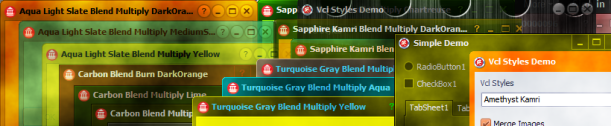
This post is just for announce which the VCL Styles Utils project now supports Delphi XE3.

This post is just for announce which the VCL Styles Utils project now supports Delphi XE3.
Delphi X3 introduces a very cool language extension, which is Record Helpers for simple types. So you can add a set of fields, properties or methods to strings, integers, Double, TDateTime and so on.
In this post I will show you the TStringHelper record helper for the string type defined in the System.SysUtils unit. Take a look to the definition of this record helper.
  TStringHelper = record helper for string
  private
    function GetChars(Index: Integer): Char; inline;
    function GetLength: Integer; inline;
    class function CharInArray(const C: Char; const InArray: array of Char): Boolean; static;
    function IndexOfAny(const Values: array of string; var Index: Integer): Integer; overload;
  public
    const Empty = '';
    // Methods
    class function Create(C: Char; Count: Integer): string; overload; inline; static;
    class function Create(const Value: array of Char; StartIndex: Integer; Length: Integer): string; overload; static;
    class function Create(const Value: array of Char): string; overload; static;
    class function Compare(const StrA: string; const StrB: string): Integer; overload; static;
    class function Compare(const StrA: string; const StrB: string; IgnoreCase: Boolean): Integer; overload; static;
    class function Compare(const StrA: string; IndexA: Integer; const StrB: string; IndexB: Integer; Length: Integer): Integer; overload; static;
    class function Compare(const StrA: string; IndexA: Integer; const StrB: string; IndexB: Integer; Length: Integer; IgnoreCase: Boolean): Integer; overload; static;
    class function CompareOrdinal(const strA: string; const strB: string): Integer; overload; static;
    class function CompareOrdinal(const strA: string; indexA: Integer; const strB: string; indexB: Integer; length: Integer): Integer; overload; static;
    function CompareTo(const strB: string): Integer;
    function Contains(const Value: string): Boolean;
    class function Copy(const Str: string): string; inline; static;
    procedure CopyTo(SourceIndex: Integer; var destination: array of Char; DestinationIndex: Integer; Count: Integer);
    class function EndsText(const ASubText, AText: string): Boolean; static;
    function EndsWith(const Value: string): Boolean; overload;
    function EndsWith(const Value: string; IgnoreCase: Boolean): Boolean; overload;
    function Equals(const Value: string): Boolean; overload;
    class function Equals(const a: string; const b: string): Boolean; overload; static;
    class function Format(const Format: string; const args: array of const): string; overload; static;
    function GetHashCode: Integer;
    function IndexOf(value: Char): Integer; overload; inline;
    function IndexOf(const Value: string): Integer; overload; inline;
    function IndexOf(Value: Char; StartIndex: Integer): Integer; overload;
    function IndexOf(const Value: string; StartIndex: Integer): Integer; overload;
    function IndexOf(Value: Char; StartIndex: Integer; Count: Integer): Integer; overload;
    function IndexOf(const Value: string; StartIndex: Integer; Count: Integer): Integer; overload;
    function IndexOfAny(const AnyOf: array of Char): Integer; overload;
    function IndexOfAny(const AnyOf: array of Char; StartIndex: Integer): Integer; overload;
    function IndexOfAny(const AnyOf: array of Char; StartIndex: Integer; Count: Integer): Integer; overload;
    function Insert(StartIndex: Integer; const Value: string): string;
    function IsDelimiter(const Delimiters: string; Index: Integer): Boolean;
    function IsEmpty: Boolean;
    class function IsNullOrEmpty(const Value: string): Boolean; static;
    class function IsNullOrWhiteSpace(const Value: string): Boolean; static;
    class function Join(const Separator: string; const values: array of const): string; overload; static;
    class function Join(const Separator: string; const Values: array of string): string; overload; static;
    class function Join(const Separator: string; const Values: IEnumerable): string; overload; static;
    class function Join(const Separator: string; const value: array of string; StartIndex: Integer; Count: Integer): string; overload; static;
    function LastDelimiter(const Delims: string): Integer;
    function LastIndexOf(Value: Char): Integer; overload;
    function LastIndexOf(const Value: string): Integer; overload;
    function LastIndexOf(Value: Char; StartIndex: Integer): Integer; overload;
    function LastIndexOf(const Value: string; StartIndex: Integer): Integer; overload;
    function LastIndexOf(Value: Char; StartIndex: Integer; Count: Integer): Integer; overload;
    function LastIndexOf(const Value: string; StartIndex: Integer; Count: Integer): Integer; overload;
    function LastIndexOfAny(const AnyOf: array of Char): Integer; overload;
    function LastIndexOfAny(const AnyOf: array of Char; StartIndex: Integer): Integer; overload;
    function LastIndexOfAny(const AnyOf: array of Char; StartIndex: Integer; Count: Integer): Integer; overload;
    function PadLeft(TotalWidth: Integer): string; overload; inline;
    function PadLeft(TotalWidth: Integer; PaddingChar: Char): string; overload; inline;
    function PadRight(TotalWidth: Integer): string; overload; inline;
    function PadRight(TotalWidth: Integer; PaddingChar: Char): string; overload; inline;
    function Remove(StartIndex: Integer): string; overload; inline;
    function Remove(StartIndex: Integer; Count: Integer): string; overload; inline;
    function Replace(OldChar: Char; NewChar: Char): string; overload;
    function Replace(OldChar: Char; NewChar: Char; ReplaceFlags: TReplaceFlags): string; overload;
    function Replace(const OldValue: string; const NewValue: string): string; overload;
    function Replace(const OldValue: string; const NewValue: string; ReplaceFlags: TReplaceFlags): string; overload;
    function Split(const Separator: array of Char): TArray; overload;
    function Split(const Separator: array of Char; Count: Integer): TArray; overload;
    function Split(const Separator: array of Char; Options: TStringSplitOptions): TArray; overload;
    function Split(const Separator: array of string; Options: TStringSplitOptions): TArray; overload;
    function Split(const Separator: array of Char; Count: Integer; Options: TStringSplitOptions): TArray; overload;
    function Split(const Separator: array of string; Count: Integer; Options: TStringSplitOptions): TArray; overload;
    function StartsWith(const Value: string): Boolean; overload;
    function StartsWith(const Value: string; IgnoreCase: Boolean): Boolean; overload;
    function Substring(StartIndex: Integer): string; overload;
    function Substring(StartIndex: Integer; Length: Integer): string; overload;
    function ToCharArray: TArray; overload;
    function ToCharArray(StartIndex: Integer; Length: Integer): TArray; overload;
    function ToLower: string;
    function ToLowerInvariant: string;
    function ToUpper: string;
    function ToUpperInvariant: string;
    function Trim: string; overload;
    function Trim(const TrimChars: array of Char): string; overload;
    function TrimEnd(const TrimChars: array of Char): string;
    function TrimStart(const TrimChars: array of Char): string;
    property Chars[Index: Integer]: Char read GetChars;
    property Length: Integer read GetLength;
  end;
Note : The same rules for the class and record helpers applies, so you can define multiple helpers with a single type. However, only zero or one helper applies in any specific location in source code and only the record helper defined in the nearest scope will apply. The record helper scope is determined in the normal Delphi fashion (for example, right to left in the unit’s uses clause).
As you can see most of the strings related methods now are part of the string type, so now you can write code like this.
{$APPTYPE CONSOLE}

uses
  System.SysUtils;

var
  s,s1 :string;
begin
  try
    // Length property
    s:='Hello Delphi XE3';
    Writeln(Format('the string Length is %d',[s.Length]));
    Writeln('The length of this literal string is '.Length);

    //function Contains
    if s.Contains('Delphi') then
      Writeln(Format('the string "%s" contains the string "%s"',[s,'Delphi']));

    //function EndsWith
    if s.EndsWith('XE3') then
      Writeln(Format('the string "%s" ends with the string "%s"',[s,'XE3']));

    //function ToLower
    Writeln(Format('using ToLower %s',[s.ToLower]));

    //function ToUpper
    Writeln(Format('using ToUpper %s',[s.ToUpper]));

    //function IndexOf
    Writeln(Format('The index of H is %d',[s.IndexOf('H')]));   //the value is based in a zero index

    //function LastDelimiter
    Writeln(Format('The first occurence of any of these chars "abcdef" is %d',[s.IndexOfAny(['a','b','c','d','e','f'])]));   //the value is based in a zero index

    //function LastDelimiter
    Writeln(Format('The last occurence of any of these chars "abcdef" is %d',[s.LastDelimiter('abcdef')]));   //the value is based in a zero index

    //function Remove
    Writeln(Format('The string with only the first 5 chars is %s',[s.Remove(5)]));   //the value is based in a zero index

    //function Replace
    Writeln(Format('Replacing the white spaces for "-", the string  becomes %s',[s.Replace(' ','-')]));   //the value is based in a zero index

    //function split
    Writeln;
    Writeln('Testing the split function');
    for s1 in s.Split([' ']) do
      Writeln(s1);
    Writeln;

    //function Substring
    Writeln(Format('The sub string starting in the index 6 is "%s"',[s.Substring(6)]));   //the value is based in a zero index
  except
    on E: Exception do
      Writeln(E.ClassName, ': ', E.Message);
  end;
  readln;
end.
Note : All the methods and properties of the System.SysUtils.TStringHelper are zero based index, so be careful when you uses functions like CopyTo, IndexOf, IndexOfAny, Insert, Join, LastDelimiter, LastIndexOf, LastIndexOfAny, Remove, Substring, ToCharArray and the Chars property.
Finally exist a few set of record helpers included in the RTL code which you can use
In RAD Studio XE3 the option (located in Tools > Options > Environment Options > VCL Designer > Embedded Designer ) to disable the Embedded Designer was hide. Personally I still using the old floating designer when I work in VCL projects.
So if you want disable the Embedded Designer just go to the the windows registry key HKEY_CURRENT_USER\Software\Embarcadero\BDS\10.0\Form Design and set the Embedded Designer value to False
Note : Remember which FireMonkey only supports the embedded form designer.
This post is just for announce which the Delphi IDE Theme Editor now supports RAD Studio XE3.
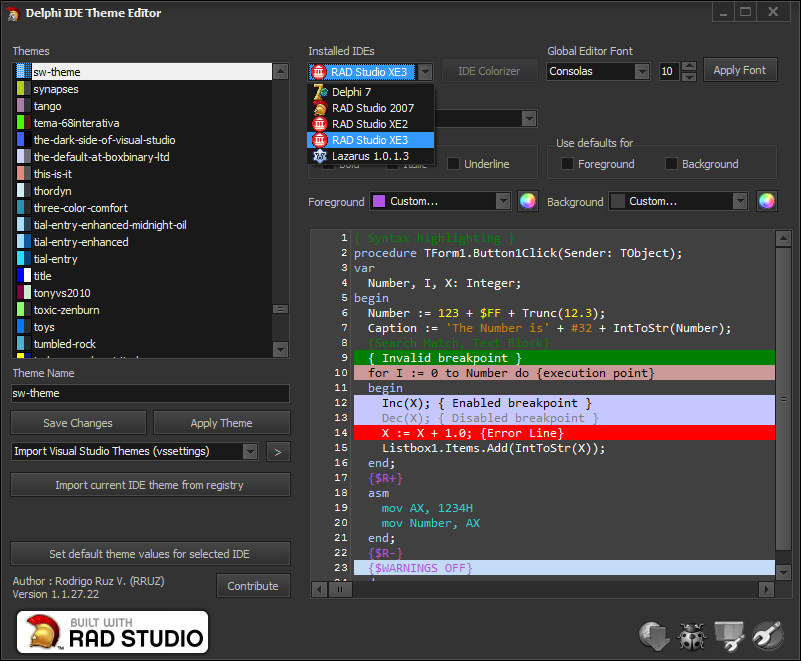
You can download the latest version from here
The TDBGrid component allows you to customize the colors of the columns and fonts used to draw the data.

Unfortunately if you uses the vcl styles all these customizations are lost

This issue is caused because the TCustomDBGrid.DrawCell method ignores the custom colors of the columns when the vcl styles are enabled. So the solution is patch this method to allow use the proper colors. After of this you will get a result like so.


I just uploaded this patch as part of the vcl styles utils project. To use it you must add the Vcl.Styles.DbGrid unit to the uses part of your form after of the Vcl.DBGrids unit.
I just uploaded a new unit to the vcl style utils project called Vcl.Styles.Fixes, this unit contains the TButtonStyleHook style hook which fix these QC #103708, #107764 reports for Delphi XE2.
Note : The QC #103708 still exist in Delphi XE2 Update 4, even if appears as resolved (XE3 maybe?)
 Some time ago I wrote a entry about how use the Bing search API from Delphi , now this API was migrated to the Windows Azure Marketplace so it’s time to upgrade the source code to access this API.
The Bing Search API allow you to get search results retrieving the results in XML or JSON format. This API offers multiple source types (or types of search results) with each query. For example you can request web, images, news, and video results for a single search query.
In order to use the Bing Search API you must obtain an account key in the Windows Azure Marketplace, Then this key must be used in a Basic Authentication scheme to authenticate the requests.
The next step is build a valid URL to make the GET request. This is the basic structure of a Bing Search URL.
https://api.datamarket.azure.com/Bing/Search/%5Bsourcetype%5D?Query=%5BSearchTerm%5D&$format=%5BResponse format]&$top=5&$skip=0
This sample URL which uses the Web source type.
https://api.datamarket.azure.com/Bing/Search/Web?Query=%27Delphi%27&$format=ATOM&$top=5&$skip=0
These are the URI Input parameters for the Web source type.
| Name | Sample values | Type | Required |
|---|---|---|---|
| Query | Hello | String | X |
| Adult | Moderate | String | |
| Latitude | 48.59 | Double | |
| Longitude | -112.31 | Double | |
| Market | en-US | String | |
| Options | EnableHighlighting | String | |
| WebFileType | XLS | String | |
| WebSearchOptions | DisableQueryAlterations | String |
These are the fields returned in the response.
| Name | Type |
|---|---|
| ID | Guid |
| Title | String |
| Description | String |
| DisplayUrl | String |
| Url | String |
Check this sample Delphi code which uses Indy to make the GET request.
{$APPTYPE CONSOLE}

{$R *.res}

uses
  MSXML,
  ActiveX,
  ComObj,
  Variants,
  IdURI,
  IdHttp,
  IdSSLOpenSSL,
  SysUtils;

procedure GetBingInfoXML_Web(const SearchKey : string;Top, Skip : Integer);
const
 ApplicationID= 'put your key here';
 URI='https://api.datamarket.azure.com/Bing/Search/Web?Query=%s&$format=ATOM&$top=%d&$skip=%d';
var
  XMLDOMDocument  : IXMLDOMDocument;
  XMLDOMNode      : IXMLDOMNode;
  cXMLDOMNode     : IXMLDOMNode;
  XMLDOMNodeList  : IXMLDOMNodeList;
  LIdHTTP : TIdHTTP;
  LIOHandler : TIdSSLIOHandlerSocketOpenSSL;
  LIndex          : Integer;
  Response: string;
begin
  LIOHandler := TIdSSLIOHandlerSocketOpenSSL.Create(nil);
  try
    LIOHandler.SSLOptions.Method := sslvTLSv1;
    LIOHandler.SSLOptions.Mode := sslmUnassigned;
    LIOHandler.SSLOptions.VerifyMode := [];
    LIOHandler.SSLOptions.VerifyDepth := 0;
    LIOHandler.host := '';

    LIdHTTP:= TIdHTTP.Create(nil);
    try
      LIdHTTP.Request.ContentEncoding := 'utf-8';
      LIdHTTP.Request.BasicAuthentication:= True;
      LIdHTTP.Request.Username:=ApplicationID;
      LIdHTTP.Request.Password:=ApplicationID;
      LIdHTTP.IOHandler:= LIOHandler;
      Response:=LIdHTTP.Get(Format(URI,[TIdURI.PathEncode(QuotedStr(SearchKey)), Top, Skip]));

      XMLDOMDocument:=CoDOMDocument.Create;
      try
        XMLDOMDocument.loadXML(Response);
        XMLDOMNode := XMLDOMDocument.selectSingleNode('/feed');
        XMLDOMNodeList := XMLDOMNode.selectNodes('//entry');

        if XMLDOMNodeList<>nil then
        for LIndex:=0 to  XMLDOMNodeList.length-1 do
        begin
           cXMLDOMNode:=XMLDOMNode.selectSingleNode(Format('//entry[%d]/content/m:properties/d:ID',[LIndex]));
           Writeln(Format('id    %s',[String(cXMLDOMNode.Text)]));
           cXMLDOMNode:=XMLDOMNode.selectSingleNode(Format('//entry[%d]/content/m:properties/d:Title',[LIndex]));
           Writeln(Format('Title %s',[String(cXMLDOMNode.Text)]));
           cXMLDOMNode:=XMLDOMNode.selectSingleNode(Format('//entry[%d]/content/m:properties/d:Description',[LIndex]));
           Writeln(Format('Description %s',[String(cXMLDOMNode.Text)]));
           cXMLDOMNode:=XMLDOMNode.selectSingleNode(Format('//entry[%d]/content/m:properties/d:DisplayUrl',[LIndex]));
           Writeln(Format('DisplayUrl %s',[String(cXMLDOMNode.Text)]));
           cXMLDOMNode:=XMLDOMNode.selectSingleNode(Format('//entry[%d]/content/m:properties/d:Url',[LIndex]));
           Writeln(Format('Url %s',[String(cXMLDOMNode.Text)]));

           Writeln;
        end;

      finally
       XMLDOMDocument:=nil;
      end;
    finally
       LIdHTTP.Free;
    end;
  finally
     LIOHandler.Free;
  end;
end;

begin
 try
    CoInitialize(nil);
    try
      GetBingInfoXML_Web('delphi programming blogs', 5, 0);
    finally
      CoUninitialize;
    end;
 except
    on E:EOleException do
        Writeln(Format('EOleException %s %x', [E.Message,E.ErrorCode]));
    on E:Exception do
        Writeln(E.Classname, ':', E.Message);
 end;
 Writeln('Press Enter to exit');
 Readln;
end.
Check this sample Delphi code which uses the IXMLHTTPRequest interface to make the GET request.
{$APPTYPE CONSOLE}

{$R *.res}

uses
  MSXML,
  ActiveX,
  ComObj,
  Variants,
  IdURI,
  SysUtils;

procedure GetBingInfoXML_Web(const SearchKey : string;Top, Skip : Integer);
const
 ApplicationID= 'put your key here';
 URI='https://api.datamarket.azure.com/Bing/Search/Web?Query=%s&$format=ATOM&$top=%d&$skip=%d';
 COMPLETED=4;
 OK       =200;
var
  XMLHTTPRequest  : IXMLHTTPRequest;
  XMLDOMDocument  : IXMLDOMDocument;
  XMLDOMNode      : IXMLDOMNode;
  cXMLDOMNode     : IXMLDOMNode;
  XMLDOMNodeList  : IXMLDOMNodeList;
  LIndex          : Integer;
begin
    XMLHTTPRequest := CreateOleObject('MSXML2.XMLHTTP') As IXMLHTTPRequest;
    XMLHTTPRequest.open('GET',Format(URI,[TIdURI.PathEncode(QuotedStr(SearchKey)), Top, Skip]), False, ApplicationID, ApplicationID);
    XMLHTTPRequest.send('');
    if (XMLHTTPRequest.readyState = COMPLETED) and (XMLHTTPRequest.status = OK) then
    begin
      XMLDOMDocument:=CoDOMDocument.Create;
      try
      XMLDOMDocument.loadXML(XMLHTTPRequest.responseText);
      XMLDOMNode := XMLDOMDocument.selectSingleNode('/feed');
      XMLDOMNodeList := XMLDOMNode.selectNodes('//entry');

        if XMLDOMNodeList<>nil then
        for LIndex:=0 to  XMLDOMNodeList.length-1 do
        begin
           cXMLDOMNode:=XMLDOMNode.selectSingleNode(Format('//entry[%d]/content/m:properties/d:ID',[LIndex]));
           Writeln(Format('id    %s',[String(cXMLDOMNode.Text)]));
           cXMLDOMNode:=XMLDOMNode.selectSingleNode(Format('//entry[%d]/content/m:properties/d:Title',[LIndex]));
           Writeln(Format('Title %s',[String(cXMLDOMNode.Text)]));
           cXMLDOMNode:=XMLDOMNode.selectSingleNode(Format('//entry[%d]/content/m:properties/d:Description',[LIndex]));
           Writeln(Format('Description %s',[String(cXMLDOMNode.Text)]));
           cXMLDOMNode:=XMLDOMNode.selectSingleNode(Format('//entry[%d]/content/m:properties/d:DisplayUrl',[LIndex]));
           Writeln(Format('DisplayUrl %s',[String(cXMLDOMNode.Text)]));
           cXMLDOMNode:=XMLDOMNode.selectSingleNode(Format('//entry[%d]/content/m:properties/d:Url',[LIndex]));
           Writeln(Format('Url %s',[String(cXMLDOMNode.Text)]));
           Writeln;
        end;

      finally
       XMLDOMDocument:=nil;
      end;
    end;

end;

begin
 try
    CoInitialize(nil);
    try
      GetBingInfoXML_Web('delphi programming blogs', 5, 0);
    finally
      CoUninitialize;
    end;
 except
    on E:EOleException do
        Writeln(Format('EOleException %s %x', [E.Message,E.ErrorCode]));
    on E:Exception do
        Writeln(E.Classname, ':', E.Message);
 end;
 Writeln('Press Enter to exit');
 Readln;
end.
The LiveBindings technology introduced in Delphi XE2, includes a set of interfaces, classes and methods to evaluate and compile expressions.
Today I will show you how you can use these classes to build, compile and evaluate simple (and complex) expressions. You can use these expressions for example to define formulas to calculate taxes, generate hashes, encrypt data or use in any situation where you need calculate a value where the values or factors may change (anyway the possibilities are endless), Also you can store these expressions in a XML file or a database and use them as needed.
Note: In this article is not used the TBindingExpression class directly, instead are used the raw classes and methods of the of livebindings expression evaluator, because you can gain much more flexibility to build your expressions.
Before to begin is necessary know the basic elements to build, compile and evaluate an expression.
The more basic expression which you can use is based in the BasicOperators Scope (located in the System.Bindings.EvalSys unit), this allows you evaluate only numbers and the basic arithmetic operations, check this sample.
{$APPTYPE CONSOLE}

uses
  System.Rtti,
  System.Bindings.EvalProtocol,
  System.Bindings.Evaluator,
  System.Bindings.EvalSys,
  System.SysUtils;

procedure DoIt;
Var
  LScope : IScope;
  LCompiledExpr : ICompiledBinding;
  LResult : TValue;
begin
  LScope:= BasicOperators;
  LCompiledExpr:= Compile('((1+2+3+4)*(25/5))-(10)', LScope);
  LResult:=LCompiledExpr.Evaluate(LScope, nil, nil).GetValue;
  if not LResult.IsEmpty then
    Writeln(LResult.ToString);
end;

begin
 try
    DoIt;
 except
    on E:Exception do
        Writeln(E.Classname, ':', E.Message);
 end;
 Writeln('Press Enter to exit');
 Readln;
end.
Now if you need evaluate the value of a constant you must create a IScope descendent and add the constants to register, finally you must merge the new scope with the original using the TNestedScope.
{$APPTYPE CONSOLE}

uses
  System.Rtti,
  System.Bindings.EvalProtocol,
  System.Bindings.Evaluator,
  System.Bindings.EvalSys,
  System.SysUtils;

procedure DoIt;
Var
  LScope : IScope;
  LCompiledExpr : ICompiledBinding;
  LResult : TValue;
  LDictionaryScope: TDictionaryScope;
begin
  LScope:= TNestedScope.Create(BasicOperators, BasicConstants);
  LDictionaryScope := TDictionaryScope.Create;
  //add a set of constants to the Scope
  LDictionaryScope.Map.Add('MinsPerHour', TValueWrapper.Create(MinsPerHour));
  LDictionaryScope.Map.Add('MinsPerDay', TValueWrapper.Create(MinsPerDay));
  LDictionaryScope.Map.Add('MSecsPerSec', TValueWrapper.Create(MSecsPerSec));
  LDictionaryScope.Map.Add('MSecsPerDay', TValueWrapper.Create(MSecsPerDay));

  //merge the scopes
  LScope:= TNestedScope.Create(LScope, LDictionaryScope);

  LCompiledExpr:= Compile('MinsPerHour*24', LScope);
  LResult:=LCompiledExpr.Evaluate(LScope, nil, nil).GetValue;
  if not LResult.IsEmpty then
    Writeln(LResult.ToString);

end;

begin
 try
    DoIt;
 except
    on E:Exception do
        Writeln(E.Classname, ':', E.Message);
 end;
 Writeln('Press Enter to exit');
 Readln;
end.
In the above code the Scope is initialized using the TNestedScope class to merge the BasicOperators and BasicConstants (this Scope define the values True, False, nil, and Pi) scopes
LScope:= TNestedScope.Create(BasicOperators, BasicConstants);
Tip 1 : The constants and identifiers in the expression are case-sensitive.
The livebindings expression evaluator include a set of basic methods (ToStr, ToVariant, ToNotifyEvent, Round, Format, UpperCase, LowerCase, FormatDateTime, StrToDateTime, Math_Min, Math_Max) which can be used in our expressions, these are defined in the System.Bindings.Methods unit and must be accessed the TBindingMethodsFactory class.
Check this sample code which uses the Format function.
{$APPTYPE CONSOLE}

uses
  System.Rtti,
  System.Bindings.EvalProtocol,
  System.Bindings.Evaluator,
  System.Bindings.EvalSys,
  System.Bindings.Methods,
  System.SysUtils;

procedure DoIt;
Var
  LScope : IScope;
  LCompiledExpr : ICompiledBinding;
  LResult : TValue;
  LDictionaryScope: TDictionaryScope;
begin
  LScope:= TNestedScope.Create(BasicOperators, BasicConstants);
  //add the registered methods
  LScope := TNestedScope.Create(LScope, TBindingMethodsFactory.GetMethodScope);
  LCompiledExpr:= Compile('Format("%s using the function %s, this function can take numbers like %d or %n as well","This is a formated string","Format",36, Pi)', LScope);
  LResult:=LCompiledExpr.Evaluate(LScope, nil, nil).GetValue;
  if not LResult.IsEmpty then
    Writeln(LResult.ToString);
end;

begin
 try
    DoIt;
 except
    on E:Exception do
        Writeln(E.Classname, ':', E.Message);
 end;
 Writeln('Press Enter to exit');
 Readln;
end.
Tip 2 : The strings in the expressions can be surrounded in double or single quotes.
Most of the times when you build an expression, you will need register a custom method, this can be easily done using the TBindingMethodsFactory class.
The first step is create a function wich returns a IInvokable interface. For this you can use the MakeInvokable method and then you write the implementation of your function as an anonymous method.
Finally using the TBindingMethodsFactory.RegisterMethod function you can register the custom method.
Check this sample code which implement a custom function called IfThen :)
{$APPTYPE CONSOLE}

uses
  System.Rtti,
  System.TypInfo,
  System.Bindings.Consts,
  System.Bindings.EvalProtocol,
  System.Bindings.Evaluator,
  System.Bindings.EvalSys,
  System.Bindings.Methods,
  System.SysUtils;

{
function IfThen(AValue: Boolean; const ATrue: Integer; const AFalse: Integer): Integer;
function IfThen(AValue: Boolean; const ATrue: Int64; const AFalse: Int64): Int64;
function IfThen(AValue: Boolean; const ATrue: UInt64; const AFalse: UInt64): UInt64;
function IfThen(AValue: Boolean; const ATrue: Single; const AFalse: Single): Single;
function IfThen(AValue: Boolean; const ATrue: Double; const AFalse: Double): Double;
function IfThen(AValue: Boolean; const ATrue: Extended; const AFalse: Extended): Extended;
}
function IfThen: IInvokable;
begin
  Result := MakeInvokable(
    function(Args: TArray<IValue>): IValue
      var
        IAValue: IValue;
        AValue: Boolean;
        IATrue, IAFalse: IValue;
     begin
        //check the number of passed parameters
        if Length(Args) <> 3 then
          raise EEvaluatorError.Create(sFormatArgError);

         IAValue:=Args[0];
         IATrue :=Args[1];
         IAFalse:=Args[2];

         //check if the parameters has values
         if IATrue.GetValue.IsEmpty or IAFalse.GetValue.IsEmpty then
          Exit(TValueWrapper.Create(nil))
         else
         //check if the parameters has the same types
         if IATrue.GetValue.Kind<>IAFalse.GetValue.Kind then
          raise EEvaluatorError.Create('The return values must be of the same type')
         else
         //check if the first parameter is boolean
         if (IAValue.GetType.Kind=tkEnumeration) and (IAValue.GetValue.TryAsType<Boolean>(AValue)) then //Boolean is returned as tkEnumeration
         begin
           if AValue then
            //return the value for True condition
            Exit(TValueWrapper.Create(IATrue.GetValue))
           else
            //return the value for the False condition
            Exit(TValueWrapper.Create(IAFalse.GetValue))
         end
         else raise EEvaluatorError.Create('The first parameter must be a boolean expression');
     end
     );
end;

procedure DoIt;
Var
  LScope : IScope;
  LCompiledExpr : ICompiledBinding;
  LResult : TValue;
  LDictionaryScope: TDictionaryScope;
begin
  LScope:= TNestedScope.Create(BasicOperators, BasicConstants);

    //add a custom method
    TBindingMethodsFactory.RegisterMethod(
        TMethodDescription.Create(
          IfThen,
          'IfThen',
          'IfThen',
          '',
          True,
          '',
          nil));

  //add the registered methods
  LScope := TNestedScope.Create(LScope, TBindingMethodsFactory.GetMethodScope);
  LCompiledExpr:= Compile('Format("The sentence is %s", IfThen(1>0,"True","False"))', LScope);
  LResult:=LCompiledExpr.Evaluate(LScope, nil, nil).GetValue;
  if not LResult.IsEmpty then
    Writeln(LResult.ToString);
end;

begin
 try
    DoIt;
 except
    on E:Exception do
        Writeln(E.Classname, ':', E.Message);
 end;
 Writeln('Press Enter to exit');
 Readln;
end.
Tip 3 : Remember use TBindingMethodsFactory.UnRegisterMethod function to unregister your custom method.
In order to use your own class in an expression you must create a Scope using the TObjectWrapper class or the WrapObject method.
{$APPTYPE CONSOLE}

uses
  System.Rtti,
  System.TypInfo,
  System.Bindings.Consts,
  System.Bindings.EvalProtocol,
  System.Bindings.Evaluator,
  System.Bindings.EvalSys,
  System.Bindings.ObjEval,
  System.SysUtils;

Type
 TMyClass= class
  function Random(Value:Integer): Integer;
 end;

{ TMyClass }
function TMyClass.Random(Value:Integer): Integer;
begin
  Result:=System.Random(Value);
end;

procedure DoIt;
Var
  LScope : IScope;
  LCompiledExpr : ICompiledBinding;
  LResult : TValue;
  LDictionaryScope: TDictionaryScope;
  M : TMyClass;
begin
  M := TMyClass.Create;
  try
    LScope:= TNestedScope.Create(BasicOperators, BasicConstants);
    //add a object
    LDictionaryScope := TDictionaryScope.Create;
    LDictionaryScope.Map.Add('M', WrapObject(M));
    LScope := TNestedScope.Create(LScope, LDictionaryScope);
    LCompiledExpr:= Compile('M.Random(10000000)', LScope);
    LResult:=LCompiledExpr.Evaluate(LScope, nil, nil).GetValue;
    if not LResult.IsEmpty then
      Writeln(LResult.ToString);
  finally
    M.Free;
  end;
end;

begin
 try
    Randomize;
    DoIt;
 except
    on E:Exception do
        Writeln(E.Classname, ':', E.Message);
 end;
 Writeln('Press Enter to exit');
 Readln;
end.
Support the WMI Delphi Code Creator in the Open Source Advertising – Sidebar – 2012
On my last post was show how get the environment variables of an external x86 process, now it’s time to show how access the same information for x64 (and x86) process from a 64 bits application.
In order to access the environment variables of a x64 process, you must use a 64 bits application, So if you compile the code posted in the last article in a 64 bits app, the code will still working but only for read the environment variables of x64 processes, this is because the offset of the fields of the records changes due to the Pointer and THandle types now have a 8 bytes size, and the structures which hold the data in a 32 bits process still using 4 bytes to represent the adresses (Pointers) and Handles (THandle). So the first step is create 2 new types to replace the Pointer and THandle types like so.
  Pointer32 = ULONG;
  THANDLE32 = ULONG;
Now using these new types we can create a 32 bits version of the records to access the PEB.
type
  Pointer32 = ULONG;
  THANDLE32 = ULONG;

  _UNICODE_STRING32 = record
    Length: Word;
    MaximumLength: Word;
    Buffer: Pointer32;
  end;
  UNICODE_STRING32 = _UNICODE_STRING32;

  _RTL_DRIVE_LETTER_CURDIR32 = record
    Flags: Word;
    Length: Word;
    TimeStamp: ULONG;
    DosPath: UNICODE_STRING32;
  end;
  RTL_DRIVE_LETTER_CURDIR32 = _RTL_DRIVE_LETTER_CURDIR32;

   _CURDIR32 = record
    DosPath: UNICODE_STRING32;
    Handle: THANDLE32;
  end;
  CURDIR32 = _CURDIR32;

  _RTL_USER_PROCESS_PARAMETERS32 = record
    MaximumLength: ULONG;
    Length: ULONG;
    Flags: ULONG;
    DebugFlags: ULONG;
    ConsoleHandle: THANDLE32;
    ConsoleFlags: ULONG;
    StandardInput: THANDLE32;
    StandardOutput: THANDLE32;
    StandardError: THANDLE32;
    CurrentDirectory: CURDIR32;
    DllPath: UNICODE_STRING32;
    ImagePathName: UNICODE_STRING32;
    CommandLine: UNICODE_STRING32;
    Environment: Pointer32;
    StartingX: ULONG;
    StartingY: ULONG;
    CountX: ULONG;
    CountY: ULONG;
    CountCharsX: ULONG;
    CountCharsY: ULONG;
    FillAttribute: ULONG;
    WindowFlags: ULONG;
    ShowWindowFlags: ULONG;
    WindowTitle: UNICODE_STRING32;
    DesktopInfo: UNICODE_STRING32;
    ShellInfo: UNICODE_STRING32;
    RuntimeData: UNICODE_STRING32;
    CurrentDirectories: array[0..31] of RTL_DRIVE_LETTER_CURDIR32;
  end;
  RTL_USER_PROCESS_PARAMETERS32 = _RTL_USER_PROCESS_PARAMETERS32;
  PRTL_USER_PROCESS_PARAMETERS32 = ^RTL_USER_PROCESS_PARAMETERS32;

  _PEB32 = record
    Reserved1     : array [0..1] of Byte;
    BeingDebugged : Byte;
    Reserved2     : Byte;
    Reserved3     : array [0..1] of Pointer32;
    Ldr           : Pointer32;
    ProcessParameters : Pointer32;//PRTL_USER_PROCESS_PARAMETERS;
    Reserved4     : array [0..102] of Byte;
    Reserved5     : array [0..51] of Pointer32;
    PostProcessInitRoutine : Pointer32;
    Reserved6     : array [0..127] of byte;
    Reserved7     : Pointer32;
    SessionId     : ULONG;
  end;
   PEB32=_PEB32;
Additional to the above changes we must modify the code to get the PEB address of a 32 bits process, this can be done using the NtQueryInformationProcess function passing ProcessWow64Information value, this will return the PEB Adresss of a process running under WOW64.
NtQueryInformationProcess(ProcessHandle, ProcessWow64Information, @PEBBaseAddress32, SizeOf(PEBBaseAddress32), nil)
And now using the ReadProcessMemory function and the new defined types we can read the environment variables block.
  //read the PEB structure
  if not ReadProcessMemory(ProcessHandle, PEBBaseAddress32, @Peb32, sizeof(Peb32), lpNumberOfBytesRead) then
    RaiseLastOSError
  else
  begin
    //read the RTL_USER_PROCESS_PARAMETERS structure
    if not ReadProcessMemory(ProcessHandle, Pointer(Peb32.ProcessParameters), @Rtl32, SizeOf(Rtl32), lpNumberOfBytesRead) then
     RaiseLastOSError
    else
    begin
       //get the size of the Env. variables block
       if VirtualQueryEx(ProcessHandle, Pointer(Rtl32.Environment), Mbi, SizeOf(Mbi))=0 then
        RaiseLastOSError
       else
       EnvStrLength :=(mbi.RegionSize -(ULONG_PTR(Pointer(Rtl32.Environment)) - ULONG_PTR(mbi.BaseAddress)));

       SetLength(EnvStrBlock, EnvStrLength);
       //read the content of the env. variables block
       if not ReadProcessMemory(ProcessHandle, Pointer(Rtl32.Environment), @EnvStrBlock[0], EnvStrLength, lpNumberOfBytesRead) then
        RaiseLastOSError
       else
       Result:=TEncoding.Unicode.GetString(EnvStrBlock);
    end;
  end;
Finally this is the full source code.
program NtQueryInformationProcess_EnvVarsX64;
//Author Rodrigo Ruz (RRUZ)
//2012-06-09
{$APPTYPE CONSOLE}

{$IFNDEF UNICODE} this code only runs under unicode delphi versions{$ENDIF}
{$R *.res}
uses
  Classes,
  SysUtils,
  Windows;

type
  Pointer32 = ULONG;
  THANDLE32 = ULONG;

  _UNICODE_STRING = record
    Length: Word;
    MaximumLength: Word;
    Buffer: LPWSTR;
  end;
  UNICODE_STRING = _UNICODE_STRING;

  //http://msdn.microsoft.com/en-us/library/windows/desktop/ms684280%28v=vs.85%29.aspx
  PROCESS_BASIC_INFORMATION = record
    Reserved1 : Pointer;
    PebBaseAddress: Pointer;
    Reserved2: array [0..1] of Pointer;
    UniqueProcessId: ULONG_PTR;
    Reserved3: Pointer;
  end;


  //http://undocumented.ntinternals.net/UserMode/Structures/RTL_DRIVE_LETTER_CURDIR.html
  _RTL_DRIVE_LETTER_CURDIR = record
    Flags: Word;
    Length: Word;
    TimeStamp: ULONG;
    DosPath: UNICODE_STRING;
  end;
  RTL_DRIVE_LETTER_CURDIR = _RTL_DRIVE_LETTER_CURDIR;

   _CURDIR = record
    DosPath: UNICODE_STRING;
    Handle: THANDLE;
  end;
  CURDIR = _CURDIR;

 //http://undocumented.ntinternals.net/UserMode/Structures/RTL_USER_PROCESS_PARAMETERS.html
  _RTL_USER_PROCESS_PARAMETERS = record
    MaximumLength: ULONG;
    Length: ULONG;
    Flags: ULONG;
    DebugFlags: ULONG;
    ConsoleHandle: THANDLE;
    ConsoleFlags: ULONG;
    StandardInput: THANDLE;
    StandardOutput: THANDLE;
    StandardError: THANDLE;
    CurrentDirectory: CURDIR;
    DllPath: UNICODE_STRING;
    ImagePathName: UNICODE_STRING;
    CommandLine: UNICODE_STRING;
    Environment: Pointer;
    StartingX: ULONG;
    StartingY: ULONG;
    CountX: ULONG;
    CountY: ULONG;
    CountCharsX: ULONG;
    CountCharsY: ULONG;
    FillAttribute: ULONG;
    WindowFlags: ULONG;
    ShowWindowFlags: ULONG;
    WindowTitle: UNICODE_STRING;
    DesktopInfo: UNICODE_STRING;
    ShellInfo: UNICODE_STRING;
    RuntimeData: UNICODE_STRING;
    CurrentDirectories: array[0..31] of RTL_DRIVE_LETTER_CURDIR;
  end;
  RTL_USER_PROCESS_PARAMETERS = _RTL_USER_PROCESS_PARAMETERS;
  PRTL_USER_PROCESS_PARAMETERS = ^RTL_USER_PROCESS_PARAMETERS;

  _PEB = record
    Reserved1     : array [0..1] of Byte;
    BeingDebugged : Byte;
    Reserved2     : Byte;
    Reserved3     : array [0..1] of Pointer;
    Ldr           : Pointer;
    ProcessParameters : PRTL_USER_PROCESS_PARAMETERS;
    Reserved4     : array [0..102] of Byte;
    Reserved5     : array [0..51] of Pointer;
    PostProcessInitRoutine : Pointer;
    Reserved6     : array [0..127] of byte;
    Reserved7     : Pointer;
    SessionId     : ULONG;
  end;
   PEB=_PEB;

{$IFDEF CPUX64}
  _UNICODE_STRING32 = record
    Length: Word;
    MaximumLength: Word;
    Buffer: Pointer32;
  end;
  UNICODE_STRING32 = _UNICODE_STRING32;

  _RTL_DRIVE_LETTER_CURDIR32 = record
    Flags: Word;
    Length: Word;
    TimeStamp: ULONG;
    DosPath: UNICODE_STRING32;
  end;
  RTL_DRIVE_LETTER_CURDIR32 = _RTL_DRIVE_LETTER_CURDIR32;

   _CURDIR32 = record
    DosPath: UNICODE_STRING32;
    Handle: THANDLE32;
  end;
  CURDIR32 = _CURDIR32;

  _RTL_USER_PROCESS_PARAMETERS32 = record
    MaximumLength: ULONG;
    Length: ULONG;
    Flags: ULONG;
    DebugFlags: ULONG;
    ConsoleHandle: THANDLE32;
    ConsoleFlags: ULONG;
    StandardInput: THANDLE32;
    StandardOutput: THANDLE32;
    StandardError: THANDLE32;
    CurrentDirectory: CURDIR32;
    DllPath: UNICODE_STRING32;
    ImagePathName: UNICODE_STRING32;
    CommandLine: UNICODE_STRING32;
    Environment: Pointer32;
    StartingX: ULONG;
    StartingY: ULONG;
    CountX: ULONG;
    CountY: ULONG;
    CountCharsX: ULONG;
    CountCharsY: ULONG;
    FillAttribute: ULONG;
    WindowFlags: ULONG;
    ShowWindowFlags: ULONG;
    WindowTitle: UNICODE_STRING32;
    DesktopInfo: UNICODE_STRING32;
    ShellInfo: UNICODE_STRING32;
    RuntimeData: UNICODE_STRING32;
    CurrentDirectories: array[0..31] of RTL_DRIVE_LETTER_CURDIR32;
  end;
  RTL_USER_PROCESS_PARAMETERS32 = _RTL_USER_PROCESS_PARAMETERS32;
  PRTL_USER_PROCESS_PARAMETERS32 = ^RTL_USER_PROCESS_PARAMETERS32;

  _PEB32 = record
    Reserved1     : array [0..1] of Byte;
    BeingDebugged : Byte;
    Reserved2     : Byte;
    Reserved3     : array [0..1] of Pointer32;
    Ldr           : Pointer32;
    ProcessParameters : Pointer32;//PRTL_USER_PROCESS_PARAMETERS;
    Reserved4     : array [0..102] of Byte;
    Reserved5     : array [0..51] of Pointer32;
    PostProcessInitRoutine : Pointer32;
    Reserved6     : array [0..127] of byte;
    Reserved7     : Pointer32;
    SessionId     : ULONG;
  end;
   PEB32=_PEB32;
{$ENDIF}
  function  NtQueryInformationProcess(ProcessHandle : THandle; ProcessInformationClass : DWORD; ProcessInformation : Pointer; ProcessInformationLength : ULONG; ReturnLength : PULONG ): LongInt; stdcall; external 'ntdll.dll';
  function  NtQueryVirtualMemory(ProcessHandle : THandle; BaseAddress : Pointer;  MemoryInformationClass : DWORD;  MemoryInformation : Pointer;  MemoryInformationLength : ULONG; ReturnLength : PULONG ): LongInt; stdcall; external 'ntdll.dll';

type
  TIsWow64Process = function(Handle:THandle; var IsWow64 : BOOL) : BOOL; stdcall;
var
  _IsWow64Process  : TIsWow64Process;

procedure Init_IsWow64Process;
var
  hKernel32      : Integer;
begin
  hKernel32 := LoadLibrary(kernel32);
  if (hKernel32 = 0) then RaiseLastOSError;
  try
    _IsWow64Process := GetProcAddress(hkernel32, 'IsWow64Process');
  finally
    FreeLibrary(hKernel32);
  end;
end;

function ProcessIsX64(hProcess: DWORD): Boolean;
var
  IsWow64        : BOOL;
begin
  Result := False;
  {$IFNDEF CPUX64}
    exit;
  {$ENDIF}
  if not Assigned(_IsWow64Process) then
   Init_IsWow64Process;

  if Assigned(_IsWow64Process) then
  begin
    if (_IsWow64Process(hProcess, IsWow64)) then
      Result := not IsWow64
    else
      RaiseLastOSError;
  end;
end;

function GetEnvVarsPid(dwProcessId : DWORD): string;
const
  STATUS_SUCCESS             = $00000000;
  SE_DEBUG_NAME              = 'SeDebugPrivilege';
  ProcessWow64Information    = 26;
var
  ProcessHandle        : THandle;
  ProcessBasicInfo     : PROCESS_BASIC_INFORMATION;
  ReturnLength         : DWORD;
  lpNumberOfBytesRead  : ULONG_PTR;
  TokenHandle          : THandle;
  lpLuid               : TOKEN_PRIVILEGES;
  OldlpLuid            : TOKEN_PRIVILEGES;

  Rtl : RTL_USER_PROCESS_PARAMETERS;
  Mbi : TMemoryBasicInformation;
  Peb : _PEB;
  EnvStrBlock  : TBytes;
  EnvStrLength : ULONG;
  IsProcessx64 : Boolean;
  {$IFDEF CPUX64}
  PEBBaseAddress32 : Pointer;
  Peb32 : _PEB32;
  Rtl32 : RTL_USER_PROCESS_PARAMETERS32;
  {$ENDIF}
begin
  Result:='';
  if OpenProcessToken(GetCurrentProcess(), TOKEN_ADJUST_PRIVILEGES or TOKEN_QUERY, TokenHandle) then
  begin
    try
      if not LookupPrivilegeValue(nil, SE_DEBUG_NAME, lpLuid.Privileges[0].Luid) then
        RaiseLastOSError
      else
      begin
        lpLuid.PrivilegeCount := 1;
        lpLuid.Privileges[0].Attributes  := SE_PRIVILEGE_ENABLED;
        ReturnLength := 0;
        OldlpLuid    := lpLuid;
        //Set the SeDebugPrivilege privilege
        if not AdjustTokenPrivileges(TokenHandle, False, lpLuid, SizeOf(OldlpLuid), OldlpLuid, ReturnLength) then RaiseLastOSError;
      end;

      ProcessHandle := OpenProcess(PROCESS_QUERY_INFORMATION or PROCESS_VM_READ, false, dwProcessId);
      if ProcessHandle=0 then RaiseLastOSError
      else
      try
        IsProcessx64 :=ProcessIsX64(ProcessHandle);

        {$IFNDEF CPUX64}
        if IsProcessx64 then
          raise Exception.Create('Only 32 bits processes are supported');
        {$ENDIF}

        {$IFDEF CPUX64}
        if IsProcessx64 then
        begin
        {$ENDIF}
          // get the PROCESS_BASIC_INFORMATION to access to the PEB Address
          if (NtQueryInformationProcess(ProcessHandle,0{=>ProcessBasicInformation},@ProcessBasicInfo, SizeOf(ProcessBasicInfo), @ReturnLength)=STATUS_SUCCESS) and (ReturnLength=SizeOf(ProcessBasicInfo)) then
          begin
            //read the PEB struture
            if not ReadProcessMemory(ProcessHandle, ProcessBasicInfo.PEBBaseAddress, @Peb, sizeof(Peb), lpNumberOfBytesRead) then
              RaiseLastOSError
            else
            begin
              //read the RTL_USER_PROCESS_PARAMETERS structure
              if not ReadProcessMemory(ProcessHandle, Peb.ProcessParameters, @Rtl, SizeOf(Rtl), lpNumberOfBytesRead) then
               RaiseLastOSError
              else
              begin
                 //get the size of the Env. variables block
                 if VirtualQueryEx(ProcessHandle, Rtl.Environment, Mbi, SizeOf(Mbi))=0 then
                  RaiseLastOSError
                 else
                 EnvStrLength :=(mbi.RegionSize -(ULONG_PTR(Rtl.Environment) - ULONG_PTR(mbi.BaseAddress)));

                 SetLength(EnvStrBlock, EnvStrLength);
                 //read the content of the env. variables block
                 if not ReadProcessMemory(ProcessHandle, Rtl.Environment, @EnvStrBlock[0], EnvStrLength, lpNumberOfBytesRead) then
                  RaiseLastOSError
                 else
                 Result:=TEncoding.Unicode.GetString(EnvStrBlock);
              end;
            end;
          end
          else
          RaiseLastOSError;
        {$IFDEF CPUX64}
        end
        else
        begin
          //get the PEB address
          if  NtQueryInformationProcess(ProcessHandle, ProcessWow64Information, @PEBBaseAddress32, SizeOf(PEBBaseAddress32), nil)=STATUS_SUCCESS then
          begin
            //read the PEB structure
            if not ReadProcessMemory(ProcessHandle, PEBBaseAddress32, @Peb32, sizeof(Peb32), lpNumberOfBytesRead) then
              RaiseLastOSError
            else
            begin
              //read the RTL_USER_PROCESS_PARAMETERS structure
              if not ReadProcessMemory(ProcessHandle, Pointer(Peb32.ProcessParameters), @Rtl32, SizeOf(Rtl32), lpNumberOfBytesRead) then
               RaiseLastOSError
              else
              begin
                 //get the size of the Env. variables block
                 if VirtualQueryEx(ProcessHandle, Pointer(Rtl32.Environment), Mbi, SizeOf(Mbi))=0 then
                  RaiseLastOSError
                 else
                 EnvStrLength :=(mbi.RegionSize -(ULONG_PTR(Pointer(Rtl32.Environment)) - ULONG_PTR(mbi.BaseAddress)));

                 SetLength(EnvStrBlock, EnvStrLength);
                 //read the content of the env. variables block
                 if not ReadProcessMemory(ProcessHandle, Pointer(Rtl32.Environment), @EnvStrBlock[0], EnvStrLength, lpNumberOfBytesRead) then
                  RaiseLastOSError
                 else
                 Result:=TEncoding.Unicode.GetString(EnvStrBlock);
              end;
            end;
          end
          else
          RaiseLastOSError;
        end;
       {$ENDIF}
      finally
        CloseHandle(ProcessHandle);
      end;
    finally
      CloseHandle(TokenHandle);
    end;
  end
  else
  RaiseLastOSError;
end;

function GetEnvVarsPidList(dwProcessId : DWORD): TStringList;
var
  PEnvVars: PChar;
  PEnvEntry: PChar;
begin
  Result:=TStringList.Create;
  PEnvVars := PChar(GetEnvVarsPid(dwProcessId));
  PEnvEntry := PEnvVars;
  while PEnvEntry^ <> #0 do
  begin
    Result.Add(PEnvEntry);
    Inc(PEnvEntry, StrLen(PEnvEntry) + 1);
  end;
end;

Var
  EnvVars : TStringList;
begin
  ReportMemoryLeaksOnShutdown:=True;
 try
   //Pass a valid pid here
   EnvVars:=GetEnvVarsPidList(5732);
   try
     Writeln(EnvVars.Text);
   finally
     EnvVars.Free;
   end;
 except
    on E:Exception do
        Writeln(E.Classname, ':', E.Message);
 end;
 Readln;
end.
 theroadtodelphi.com